Develop Evidence-Based Nutrition Interventions
Applied Nutrition and Behavior Change: Foundations for Health and Wellness
 Application closes on
17th Sep 2026
Application closes on
17th Sep 2026
 Speak with our expert
+16176762908
Speak with our expert
+16176762908




Learn more about the course
Get details on syllabus, projects, tools, and more
Applied Nutrition and Behavior Change: Foundations for Health and Wellness
Application closes 17th Sep 2026
Why Should You Join This Program?
-

Evidence-Backed Curriculum
Learn from a rigorously research-driven program that integrates metabolic science, precision nutrition, gut microbiome research, and behavior-change models.
-
Learn from Harvard Chan School
Learn from expert faculty whose research has shaped clinical strategy and public health policy from dietary guidelines to chronic disease prevention and improved health outcomes for millions worldwide


LEARNING OUTCOMES
What Will You Learn in the Program?
Through a structured learning journey, you will build the capability to:
-
Apply nutrition science principles to design evidence-based recommendations for diverse populations
-
Evaluate the validity of precision nutrition approaches, digital health tools, and dietary strategies
-
Develop integrated dietary strategies for chronic disease prevention, metabolic health, and weight management
-
Design behavior-change programs and institutional nutrition interventions using evidence-based frameworks
-
Align nutrition strategies with global public health priorities, sustainability, and broader health goals
KEY PROGRAM HIGHLIGHTS
Why Choose This Program?
-
Learn from Harvard Chan Faculty
Learn through live masterclasses by Harvard Chan faculty, along with weekly live mentorship learning sessions led by industry practitioners who help translate theory into strategy.
-
Evidence-Backed Curriculum
Learn from a comprehensive curriculum that integrates nutrition science, metabolism, precision nutrition, and dietary patterns grounded in rigorous research.
-
Research-Backed Behavior Change Frameworks
Learn to drive sustainable behavior change using proven frameworks such as COM-B and motivational interviewing to support lasting dietary and lifestyle change.
-
No Prerequisites
Open to all professionals and individuals interested in learning about evidence-based nutrition and behavior change.
-
Learning Support
Get personalized assistance from a dedicated program manager and academic support through the Great Learning community, project discussion forums, and peer groups.
-
Earn a Highly Reputable Credential
Receive a Certificate of Completion from Harvard T.H. Chan School of Public Health upon program completion.


Skills You Will Learn
Nutrition Planning
Macronutrient and Micronutrient Analysis
Clinical Assessment
Digital Monitoring
Dietary Coaching
Public Health Strategy
Policy Design
Evidence-Based Strategies
Implementation Science
BEHAVIOR CHANGE (COM-B MODEL AND NUDGE THEORY)
Nutrition Planning
Macronutrient and Micronutrient Analysis
Clinical Assessment
Digital Monitoring
Dietary Coaching
Public Health Strategy
Policy Design
Evidence-Based Strategies
Implementation Science
BEHAVIOR CHANGE (COM-B MODEL AND NUDGE THEORY)
view more
- Overview
- Learning Journey
- Curriculum
- Projects
- Certificate
- Faculty
- Fees
- FAQ
Who is the Program for?
Professionals looking to translate research into effective nutrition strategies
-
Health Care and Nutrition Professionals
Seeking to apply evidence-based nutrition science and behavior-change strategies to improve patient and client outcomes.
-
Health and Wellness Professionals
Who want to help clients achieve lasting health improvements through sustainable dietary and lifestyle changes.
-
Public Health and Community Health Leaders
Responsible for designing and implementing nutrition initiatives for improving population health.
-
Corporate and Institutional Health Leaders
Looking to create healthier food environments through nutrition and behavior-change strategies across workplaces, schools, hospitals, and communities.
-
Health Innovation Professionals
Who want to integrate evidence-based nutrition into products, programs, and population health solutions.
-
Digital Health Professionals
Building digital health solutions and who need to apply evidence-based nutrition and behavior-change principles at scale.
How is the Program Learning Experience?
Learn evidence-based nutrition through hands-on, real-world application
-
Learn from Practitioners
Learn from Harvard Chan faculty and leading nutrition and public health practitioners
-
Learn By Doing
Hands-on learning that translates cutting-edge nutrition science into evidence-based strategies
-
Earn a University Credential
Receive a Certificate of Completion from Harvard T.H. Chan School of Public Health
-
Get Support Throughout the Learning Journey
Program managers will help you stay on track, navigate key milestones & complete the program




What Will You Learn in the Program?
The comprehensive curriculum combines evidence-based nutrition science, behavior change, and public health principles designed to help professionals translate research into effective nutrition strategies
Module 01 | Fundamentals of Nutrition Science
This module lays the scientific foundation of the program, covering the foundations of nutrition science, research methods, metabolism, nutrient quality, and emerging areas like precision nutrition and the gut microbiome. Learners develop skills to critically evaluate nutrition evidence, understand how dietary patterns affect health, and assess the validity of digital health tools.
Week 1: Foundations of Applied Nutrition Science and Metabolism
Week 2: From Nutrient Quality to Global Dietary Patterns
Week 3: Precision Nutrition and the Microbiome
Module 02 | Applied Nutrition Across the Lifespan and Weight Management
This module applies nutrition science across the lifespan, covering chronic disease prevention, metabolic health, age-specific needs, and modern weight management in the GLP-1 era. Learners gain skills to design integrated dietary strategies, create age-appropriate nutrition frameworks, and critically evaluate weight loss protocols.
Week 4: Metabolic Health and Chronic Disease Defense
Week 5: Nutrition Across the Lifespan
Week 6: Nutrition and Weight Control in the GLP-1 Era
Module 03 | Behavior Change, Nutrition at Scale, and Global Health
This module moves from individual practice to system-level impact and public health. Learners gain skills to apply behavior-change models, design scalable interventions for workplaces, schools, and hospitals, and align nutrition strategies with environmental sustainability and global health challenges.
Week 7: Behavioral Changes and Lifestyle Medicine
Week 8: Nutrition in Communities, Institutions, and Workplaces
Week 9: Global Nutrition, Sustainability, and Planetary Health
Note: The curriculum listed above are indicative and subject to updates as technology evolves.
What Are the Sample Projects & Case Studies?
Apply nutrition science and behavior-change frameworks through real-world case studies and projects.

PROJECT
Personalized Nutrition Plan for a Chronic Health Condition
Description
Select a patient profile and design a nutrition plan based on evidence-based dietary patterns. Address macronutrient and micronutrient requirements specific to the condition or life stage, and justify recommendations using current research.
Skills you will learn
- Nutrition Planning
- Evidence-Based Practice
- Macronutrient and Micronutrient Analysis
- Clinical Assessment

PROJECT
Behavioral Coaching Strategy
Description
Design a 21-day personal plan to improve daily energy levels and support weight management. Apply the COM-B model to identify barriers to dietary change, track adherence using a digital tool, and summarize insights in a report.
Skills you will learn
- Behavior Change
- COM-B Model
- Digital Monitoring
- Dietary Coaching

PROJECT
Public Health Nutrition Policy and Environment Plan
Description
Select an urban setting in a low- and middle-income country (LMIC) and design a multisectoral intervention addressing the double burden of malnutrition. Propose evidence-based policy changes and apply nudge theory and implementation science to overcome adoption barriers.
Skills you will learn
- Public Health Strategy
- Policy Design
- Nudge Theory
- Implementation Science

CASE STUDY
Designing an Age-Specific Nutrition Framework
Description
Understand the role of dietary factors in promoting healthy aging and extending health span in patients over 65. Evaluate nutritional strategies and frameworks tailored to support cognitive health and prevent sarcopenia in aging populations.
Skills you will learn
- Age-Specific Nutrition
- Cognitive Health
- Healthy Aging
- Dietary Evaluation


Note: The projects listed above are indicative and subject to updates to the curriculum.
Earn Elite Credentials to Showcase to Your Network
Receive a Certificate of Completion from Harvard T.H. Chan School of Public Health upon program completion.
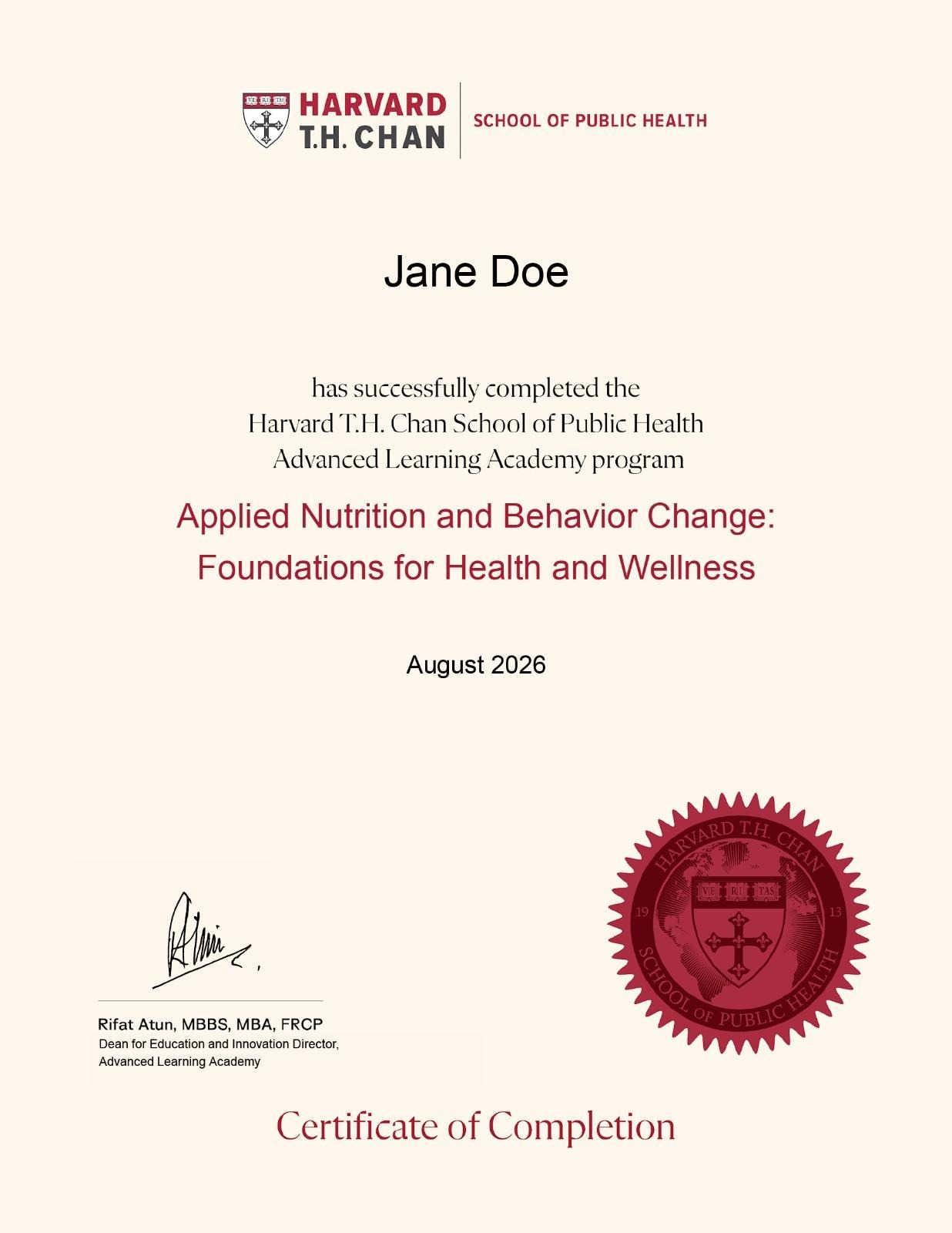
* Image for illustration only. Certificate subject to change.
Who Are the Faculty for the Program?
Learn from renowned faculty and build technical intuition to make credible, strategic decisions
-
Cindy Leung
Associate Professor of Public Health Nutrition Harvard T.H. Chan School of Public Health
Faculty Director
Research on Nutrition, Policy, and Chronic Disease Risk
Know More -
Frank B. Hu
Fredrick J. Stare Professor of Nutrition and Epidemiology, Chair of Department of Nutrition Harvard T.H. Chan School of Public Health
Department of Epidemiology and Nutrition
Professor of Medicine, Harvard Medical School
Know More -
Wafaie W. Fawzi
Richard Saltonstall Professor of Population Sciences and Professor of Nutrition, Epidemiology, and Global Health, Harvard T.H. Chan School of Public Health
Department of Epidemiology and Nutrition
Department of Global Health and Population
Know More -
Shalu H. Ramchandani
Instructor, Department of Medicine, Massachusetts General Hospital
Board Certified in Internal Medicine, Obesity Medicine, and Health
Physician, Massachusetts General Hospital
Know More -
Erica Kenney
Associate Professor of Public Health Nutrition, Harvard T.H. Chan School of Public Health
Department of Nutrition
Department of Social and Behavioral Sciences
Know More -
Danielle E. Haslam
Instructor in Medicine, Brigham and Women's Hospital and Harvard Medical School
Research Associate, Nutrition, Harvard Chan School
Department of Nutrition
Know More -
Shilpa Bhupathiraju
Associate Professor of Medicine, Brigham and Women's Hospital, Harvard Medical School
Associate Professor, Department of Nutrition
Harvard T.H. Chan School of Public Health
Know More -
Daniel Wang
Assistant Professor, Department of Nutrition, Harvard T.H. Chan School of Public Health
Department of Nutrition
Assistant Professor of Medicine, Harvard Medical School
Know More







 LinkedIn Profile
 University Link
Course Fees
The course fee is USD 3,000
Invest in your career
-
Apply nutrition science principles to design evidence-based recommendations for diverse populations
-
Evaluate the validity of precision nutrition approaches, digital health tools, and dietary strategies
-
Develop integrated dietary strategies for chronic disease prevention, metabolic health, and weight management
-
Design behavior-change programs and institutional nutrition interventions using evidence-based frameworks


Easy payment plans
Avail our EMI options & get financial assistance
-
INSTALLMENT PLANS
Upto 3 months Installment plans
Explore our flexible payment plans
View Plans
Third Party Credit Facilitators
Check out different payment options with third party credit facility providers


*Subject to third party credit facility provider approval based on applicable regions & eligibility

Application Process
Admissions are rolling and will close once the cohort is full. Apply early to secure your spot.
-
Apply
Fill out an online application form
-
Review
Eligible applications will be reviewed by a panel from Great Learning
-
Join
An offer letter will be sent to the selected candidates


No Prerequisites
- Open to all professionals and individuals interested in learning about evidence-based nutrition and behavior change.
Batch Start Date
-
Online · 15th Nov 2026
Admission closing soon
Frequently Asked Questions
Can I study nutrition online while working full-time?
Yes, you can study nutrition online while working full-time. The Applied Nutrition and Behavior Change: Foundations for Health and Wellness program is designed specifically to be accessible for busy professionals. The coursework combines recorded lectures from Harvard Chan faculty that you can watch on your own schedule, along with live masterclasses and weekly live mentorship sessions led by industry practitioners. This allows you to build expertise in evidence-based nutrition and behavior change without needing to step away from your current career.
How many hours per week does this online nutrition program require?
5-7 hours per week.
Will I receive a certificate after completing the program?
Yes. Participants receive a Certificate of Completion from Harvard T.H. Chan School of Public Health after successfully completing the program requirements.
What makes this Harvard Chan School nutrition program different from other nutrition certificate programs online?
Harvard Applied Nutrition and Behavior Change: Foundations for Health and Wellness integrates nutrition science with implementation science, behavior change, and public health to prepare professionals working across clinical, community, workplace, and population health settings. The nine-week online program includes faculty-led masterclasses, live mentorship sessions, hands-on projects, and a Certificate of Completion from Harvard T.H. Chan School of Public Health.
How can this nutrition program help me apply evidence-based nutrition in real-world practice?
This nutrition program helps you translate nutrition science into practical decision-making through real-world case studies, hands-on projects, and evidence-based frameworks. You'll learn to evaluate nutrition research, create personalized nutrition strategies, and design evidence-based interventions for communities and organizations with confidence.
Does this nutrition program include real-world projects?
Yes. The curriculum includes projects such as creating a personalized nutrition plan, designing a behavioral coaching strategy, and developing public health nutrition interventions using evidence-based frameworks.
Will I learn how to create a personalized nutrition plan?
Yes. One of the applied projects focuses on designing individualized nutrition approaches and broader nutrition initiatives designed for workplaces, schools, hospitals, and communities.
Does the curriculum cover glucagon-like peptide-1 (GLP-1) medications and weight management?
Yes. The program explores nutrition and lifestyle considerations for individuals using GLP-1 therapies, evidence-based weight management strategies, and approaches to maintaining muscle mass and long-term metabolic health.
Who teaches this program?
The program features faculty from Harvard T.H. Chan School of Public Health with expertise in nutrition, epidemiology, metabolic health, public health nutrition, and chronic disease prevention, along with weekly mentorship from industry practitioners.
Who are nutrition and wellness coaching programs for?
The Applied Nutrition and Behavior Change program is designed for health care professionals, public health and community leaders, and organizational decision makers who want to apply evidence-based nutrition science and behavior-change strategies to improve health outcomes, guide clinical and community interventions, and lead innovation in metabolic health.
Do I need a nutrition background to join this program?
No. There are no formal prerequisites. While professionals working in health care, wellness, and public health may benefit the most, anyone interested in evidence-based nutrition can apply.
Can this program help me understand how to become a holistic nutritionist?
This program builds a strong foundation in evidence-based nutrition and behavior change. Whether it supports your path toward becoming a holistic nutritionist depends on your country's professional requirements, licensing, or certification standards.
How does the admission process work?
Admissions are conducted on a rolling basis. Applicants complete an online application, eligible applications are reviewed, and selected candidates receive an offer to join the program.
What is the fee for this Harvard Chan School nutrition program?
The program fee is US$3,000. Flexible payment plans may be available through Great Learning.
Are flexible payment options available?
Yes. Participants can contact a Great Learning Program Advisor to learn about available payment plans and financing options.
What skills will I gain from the Harvard Chan School nutrition certificate program?
This Harvard Chan School’s Nutrition Program equips you with practical skills to apply evidence-based nutrition in clinical, wellness, and public health settings. You'll learn to:
- Apply nutrition science principles to design evidence-based recommendations for diverse populations.
- Design behavior-change programs and institutional nutrition interventions using evidence-based frameworks for scalable, real-world impact.
- Develop integrated dietary strategies for chronic disease prevention, metabolic health, and weight management, and evidence-based weight management strategies, including GLP-1 nutrition.
- Evaluate the scientific validity of precision nutrition approaches, digital health tools, and emerging dietary strategies for clinical and consumer use.
- Align nutrition strategies with global public health priorities, environmental sustainability, and broader health goals.
How can an online nutrition course help me address nutrition misinformation?
An online nutrition course helps you distinguish evidence-based nutrition from misinformation by teaching you how to critically evaluate research, including RCTs, cohort studies, and meta-analyses. You'll also learn to assess emerging nutrition trends, precision nutrition approaches, and digital health tools to make informed, evidence-based recommendations.
How can experienced health care professionals apply nutrition science in their current roles?
Experienced health care professionals can use nutrition science to improve clinical decision-making, personalize nutrition strategies, support chronic disease management, and design evidence-based interventions. This program equips learners with practical frameworks and real-world applications to strengthen patient and population health.
What is the difference between a nutrition course and a nutrition certification?
A nutrition course helps you build knowledge and practical skills in nutrition science and its real-world applications. A nutrition certification typically refers to a professional credential awarded by a certifying body after meeting specific education, training, or examination requirements.
What is precision nutrition?
Precision nutrition is an emerging scientific frontier focused on personalized nutrition. Rather than taking a one-size-fits-all approach to diet, precision nutrition involves "measuring the individual" through advanced scientific techniques such as omics, genomics, and digital health tools. It is also deeply connected to the study of the gut microbiome, specifically analyzing how an individual's unique microbiome composition and function interact with their diet
How do evidence-based nutrition recommendations improve patient care?
Evidence-based nutrition recommendations help health care professionals make informed clinical decisions using proven research rather than diet trends. They support better management of chronic diseases, improve patient care, strengthen community nutrition programs, and inform organizational nutrition strategies.
Delivered with support from:

Harvard Chan Advanced Learning Academy delivers the Applied Nutrition and Behavior Change: Foundations for Health and Wellness program with support from Great Learning. Great Learning manages enrollment, including payment processing and invoicing, as well as technology and participant support.
 Application closes
17th Sep 2026
Application closes
17th Sep 2026