phone iconSpeak with our expert +16176186652

Trusted by millions of learners

Learn more about the course

Get details on syllabus, projects, tools, and more

Name
Email
Mobile Number

By submitting this form, you consent to our Terms of Use & Privacy Policy and consent to be contacted via email, phone (including by AI-generated/pre-recorded voice calls), SMS, or WhatsApp.

AI in Health Care Systems: Deploying AI Solutions at Scale

AI in Health Care Systems: Deploying AI Solutions at Scale

Application closes 24th Sep 2026

Why Should You Join This Program?

  • List icon

    Research-Informed Curriculum

    Learn from a research-driven curriculum grounded in Harvard's health care system framework, integrating health care systems science, AI deployment models, workflow integration, and governance

  • List icon

    Learn from Harvard Chan School

    Learn from expert faculty whose research has shaped clinical strategy and public health policy from dietary guidelines to chronic disease prevention and improved health outcomes for millions worldwide

LEARNING OUTCOMES

What Will You Learn in the Program?

Through a structured learning journey, you will build the capability to:

  • Frame the right problem for AI from a real care gap, judging whether AI belongs at all, wherever decisions sit

  • Deploy AI into real systems, seeing what it takes beyond data and models, and hold accountability

  • Govern AI across its lifecycle for safety and equity, from fairness testing to monitoring

  • Distinguish AI approaches and know which challenge calls for predictive, GenAI, deep learning, or agentic AI

  • Scale a solution from one site to whole populations so it narrows the gap in care rather than widening it

  • Make the case for AI by uniting technical, ethical, and operational factors in a clear problem definition

KEY PROGRAM HIGHLIGHTS

Why Choose This Program?

  • List icon

    Learn from Harvard Chan Faculty

    Learn through live masterclasses by Harvard Chan faculty, along with weekly live mentorship learning sessions led by industry practitioners who help translate theory into strategy

  • List icon

    Research-Informed Curriculum

    Learn from a comprehensive curriculum that integrates real-world AI deployment models, workflow integration, scaling strategies, and governance frameworks

  • List icon

    Capstone Project

    Design an end-to-end AI solution for a real-world health care problem and define the value it creates, with clear metrics for effectiveness, efficiency, equity, and health outcomes

  • List icon

    Applied Learning

    Apply deployment and governance frameworks to real-world case studies, analyzing how AI solutions have scaled from pilots to system-wide adoption

  • List icon

    Learning Support

    Get personalized assistance from a dedicated program manager and academic support through the Great Learning community, project discussion forums, and peer groups

  • List icon

    Earn a Highly Reputable Credential

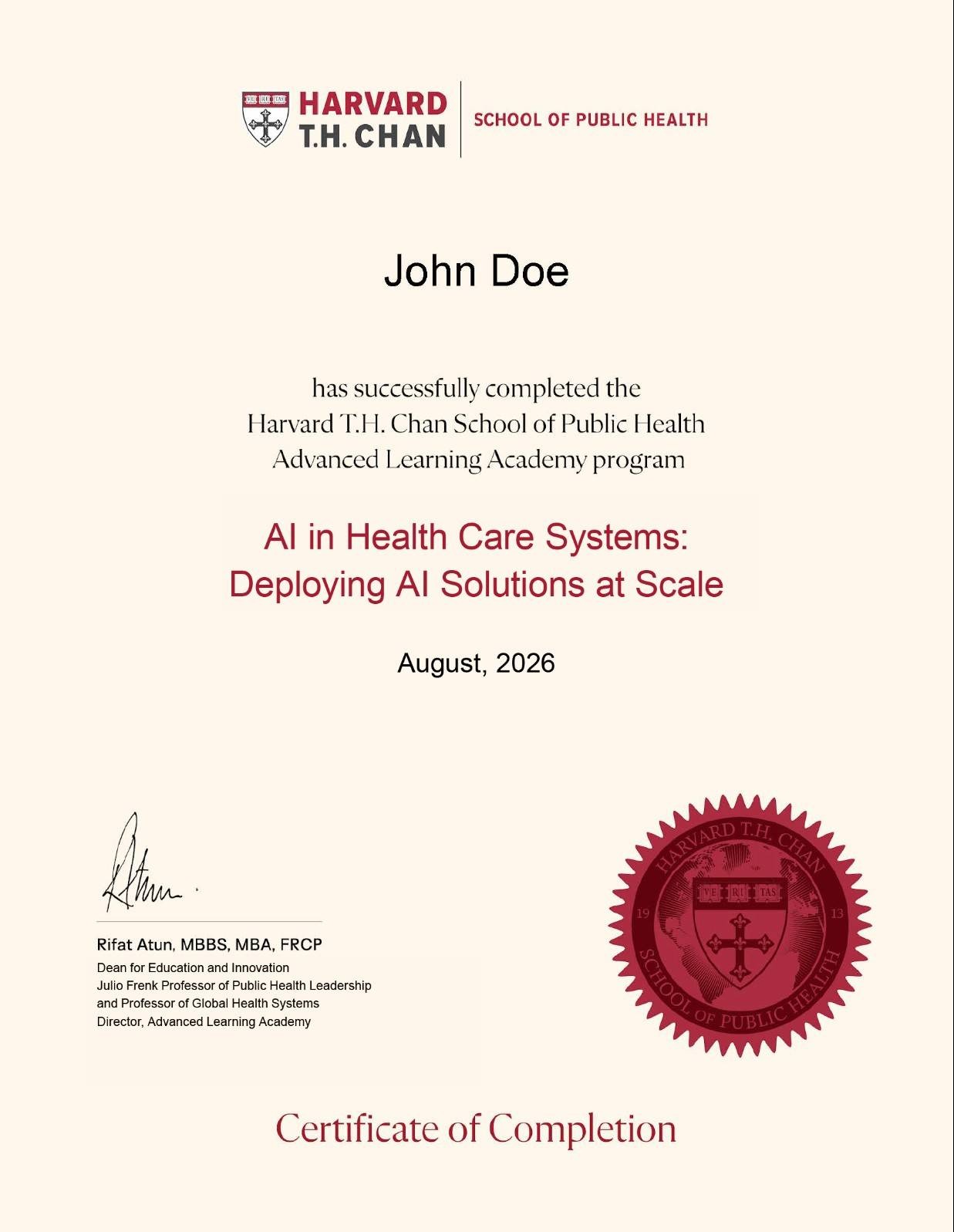
    Receive a Certificate of Completion from Harvard T.H. Chan School of Public Health upon program completion

Skills You Will Learn

Health Systems Analysis

AI-Powered Regulatory Compliance

AI Deployment in health care systems

Clinical Workflow Integration

AI Governance

Responsible AI

Clinical Decision Support

Health Data Management

Health Systems Analysis

AI-Powered Regulatory Compliance

AI Deployment in health care systems

Clinical Workflow Integration

AI Governance

Responsible AI

Clinical Decision Support

Health Data Management

view more

  • Overview
  • Learning Journey
  • Curriculum
  • Projects
  • Certificate
  • Faculty
  • Mentors
  • Fees

Who is the Program for?

Health system leaders and decision-makers responsible for adopting and scaling AI across health systems

  • Health Care Administrators and Program Managers

    Who oversee health service delivery and drive AI initiatives that improve operational efficiency, workflow integration, and patient care.

  • Health System, Clinical, and Payer Leaders

    Who shape clinical strategy, oversee health system and payer operations, and make decisions about AI investment, governance, and implementation

  • Health Informatics and Analytics Professionals

    Including innovation leaders who evaluate, select, and govern AI to improve clinical decision-making, operational performance, and outcomes

  • Health Care Consultants

    Who advise health care organizations on AI strategy, implementation, and transformation to improve quality, efficiency, and equitable care

  • Public and Government Health Professionals

    Who assess AI-enabled initiatives against population health goals and evaluate their impact on access and equity.

How is the Program Learning Experience?

Build system-level AI expertise in health care through hands-on, real-world application

  • banner-image

    Learn from Practitioners

    Learn from Harvard Chan faculty and leading health care practitioners

  • banner-image

    Learn By Doing

    Hands-on learning designed to create measurable value across diverse health care environments

  • banner-image

    Earn a University Credential

    Receive a Certificate of Completion from Harvard T.H. Chan School of Public Health

  • banner-image

    Get Support Throughout the Learning Journey

    Program managers will help you stay on track, navigate key milestones & complete the program

What Will You Learn in the Program?

Learn from a systems-level curriculum grounded in Harvard's High-Value Health Care System framework, integrating real-world AI deployment models, workflow integration, scaling strategies, and governance frameworks for safety, equity, and performance at scale.

Foundational Module

This module sets the foundation with a health systems view of value, covering functions, outputs, outcomes, and the objectives of effectiveness, efficiency, equity, and responsiveness that frame every AI decision that follows.

Health Systems Analysis: Setting Up Effective AI Solutions

Map any health system problem onto a health systems framework, working out whether it sits in a function, an output, or an outcome, then judge a health service against four value objectives to pinpoint where value is created or lost. From a country case, diagnose which part of the system underperforms and where AI could add the most value. Topics Covered: - Health systems framework and systems thinking for designing and deploying AI - Health system functions: governance, financing, and resource management - Health system outputs: public-health and personal medical services - Health system objectives: effectiveness, efficiency, equity, and responsiveness - Health system outcomes: health, financial protection, and user satisfaction - Value creation and identifying high-value entry points for AI in health systems

Module 01 | AI Fundamentals and Problem Identification in Health Systems

This module establishes what AI is and how to frame a health system problem for AI to solve.

Week 01 | Core AI Concepts for Health Systems

Distinguish between machine-learning types (supervised, unsupervised, and reinforcement) and AI models (deep, foundation, and frontier) using health care examples. Compare agentic AI that keeps a human in the loop with autonomous agents, identify critical data dependencies, and align AI methods with specific health system needs. Topics Covered: - Illustrative health applications (imaging, prediction), used to anchor the concepts - Machine learning: supervised, unsupervised, and reinforcement learning - Deep learning, foundation models, and frontier models - Agentic AI and AI agents (human-in-the-loop) versus autonomous agents - Data needs and considerations common to all approaches - Matching AI methods to real-world health system use cases

Week 02 | Framing the Right Problems for AI in Health Systems

Frame health system problems within the framework of functions, outputs, and outcomes to determine suitability for AI. Evaluate candidates against value objectives and evidence of AI-driven impact, quantify system underperformance to prioritize high-value use cases, and assess potential algorithmic bias risks. Topics Covered: - Defining system problems for AI solutions - AI for health systems: a family of problems and solutions - Quantifying health system challenges across functions, outputs, and outcomes - The evidence base for AI solutions, and how they create value across the four objectives - Algorithmic bias in health systems - The Recursive Care Law

Module 02 | The Types of AI and Their Health Care Applications

This module explores the major families of AI, including predictive, generative, deep learning, and agentic AI, each anchored in a real-world solution.

Week 03 | Predictive AI: Forecasting Demand and Capacity

Explain how predictive AI forecasts demand for health services and how a real-time model matches workforce supply to that demand, turning a forecast into better-used clinician time. Evaluate the operational benefits and risks of predictive staffing models in primary care. Topics Covered: - Health workforce and human-resource management - Primary and home-based clinical care (injections, pre-operative/post-operative support, and clinical trials) - Predictive machine learning and forecasting, using historical and real-time demand data - Real-time demand-supply optimization - Scheduling, routing, and targeted deployment of the workforce - Capacity planning and informing hiring decisions

Week 04 | Generative AI for Clinical Documentation and Patient Communication

Describe how generative AI turns unstructured patient and clinical narratives into usable information. Examine how human-centered design shapes responsible implementation in health care. Topics Covered: - Clinician administrative burden and burnout - Clinical documentation and patient-friendly post-visit communication - Human-centered design and patient participation in care decisions - Generative AI and large language models: summarization and draft generation - From clinical pilot to care-journey redesign and organizational scaling - Safeguards for generative output in clinical settings

Week 05 | Deep Learning and Generative AI in Medical Imaging and Care Coordination

Describe how deep learning optimizes medical imaging (screening, diagnostics, care coordination) through workflow-integrated detection and navigation. Trace the evolution from single-modality diagnosis to whole-pathway management and its regulatory implications. Evaluate operational benefits such as efficiency gains and reduced clinician burden and assess the investment case for health systems. Topics Covered: - Medical imaging and radiology: screening and diagnostics - Deep learning for detection, with navigation built into a single workflow - Integration with PACS, EMR, and reporting systems without changing workflows - Radiology workflow orchestration, longitudinal tracking, and care coordination - The evolution from single-modality diagnosis to whole-pathway management - Regulatory-pathway strategy - The investment case and return on investment for health systems (radiology versus cancer)

Week 06 | Agentic AI as the Orchestration Layer for Clinical Workflows

Explain what makes a system "agentic" and how an agent that plans, acts, and knows when to defer differs from a single-purpose tool. Describe how a multi-agent approach coordinates several capabilities at once across a clinical encounter. Outline a human-in-the-loop workflow with the clinician as the control point, and weigh the added risks agents introduce. Topics Covered: - Care-delivery orchestration, clinical decision support - Multi-step clinical and operational workflows - Agentic AI and multi-agent systems - Tool use and agent coordination across multiple model types - Human-in-the-loop orchestration - Underserved-population access - Practical use cases of clinical agents

Module 03 | From Deployment to Scale: Engineering AI into Health Systems

This module moves from what AI can do to how it is engineered into a real system, including deployment, integration, and scaling across contexts.

Week 07 | Deploying AI Systems into Real Clinical Workflows

Map the end-to-end clinical deployment pathway from defining unmet needs to validation, regulatory strategy, and workflow integration. Evaluate the impact of AI on care delivery, identifying strategies to mitigate algorithmic bias, uphold ethical standards, and ensure sustained clinical performance. Topics Covered: - Idea generation from unmet clinical needs - Hospital operations and diagnostic deployment - Health data: sources, collection, curation, and management - Model development and validation - Algorithmic bias management; health data regulation and ethics - Workflow integration, patenting, and publication - Post-deployment monitoring, iterative improvement, and regulatory pathway

Week 08 | AI-Enabled Analytics for Health System Decision-Making

Explain the operational command-center concept and why a single, governed view of every AI model matters to a health system, and describe how a system's many models can be routed through one enterprise platform. Compare the visibility of an integrated platform against fragmented point solutions, and interpret what it reveals about AI's real impact across an organization. Topics Covered: - Integrating disconnected health care data into a unified, structured patient record - An "always-on," longitudinal view of the patient journey across care settings - Real-time insight into a patient's journey wherever they receive care - Technical and organizational requirements for actionable patient data - The value of real-time, longitudinal patient data for care coordination

Week 09 | Scaling Health Services Infrastructure and Care Delivery

Identify the deployment considerations involved in scaling health services infrastructure. Compare urban and rural service models, including safety-net services and telehealth. Evaluate how clinician-supervised AI expands access for vulnerable populations while maintaining clinical quality and governance at scale. Topics Covered: - Primary and specialty care networks; urban and rural delivery - Safety-net services (street medicine, care management) for underserved populations - AI-driven clinical assistant and care-delivery platform; human-in-the-loop clinical agent - Telehealth for consultation, treatment recommendations, and referrals - EMR-integrated care delivery - Expanding in-person care capacity at scale

Week 10 | Scaling AI Across Health Systems and Income Levels

Explain what it means to scale a single AI solution beyond one site, and why scaling across contexts is harder than deploying once. Analyze the factors that enable scaling across countries and income levels, including multi-jurisdiction regulatory clearance. Evaluate what must stay constant and what has to adapt as a solution scales. Topics Covered: - Scaling AI solutions beyond a single point solution - Deploying across 105 countries, from low-resource to high-resource contexts - Strategic change and stakeholder engagement - Multi-jurisdiction regulatory clearance as an enabler of scale - The D3A3 model for context-specific deployment

Module 04 | Governance, Oversight, and Trust in Health Care AI

This final module focuses on trust, oversight, and governance, examining how AI is kept safe, equitable, and accountable once deployed in real-world health care settings.

Week 11 | Building Trustworthy AI for High-Stakes Clinical Decisions

Differentiate accuracy from safety and explain why a model that scores well can still be unsafe in practice. Describe the role of explainable AI and guardrails in a high-stakes screening context. Identify the failure modes such a system must be tested against. Outline the governance considerations needed to deploy screening AI responsibly. Topics Covered: - Cancer screening, mammography, and high-stakes diagnostics - Accuracy versus safety - Explainable AI; safe AI/guardrails; uncertainty awareness - Edge-case and failure-mode analysis; patient-subgroup safety - Zero-error tolerance; human-in-the-loop oversight and clinical governance - Usability in the clinical workflow

Week 12 | AI Governance across the AI-Lifecycle—Design, Post-Deployment Monitoring, and Equity Oversight

Apply a responsible-AI governance framework to assess an organization's AI policy, structures, and risk categorization. Describe the practices that sustain responsible AI across its lifecycle, from ongoing model monitoring and validation to responsible data management, and design the education, training, and adverse-event reporting that maintain governance certification. Topics Covered: - The CHAI (Coalition for Health AI) governance framework - Organizational AI policy, structures, and resources - Responsible-AI lifecycle management: monitoring, validation, and maintenance - Risk and impact assessment: the CHAI Risk Categorization Tool - Responsible data management: ethics, privacy, and security - Third-party evaluation, education, training, and adverse-event reporting for certification

Capstone Project | Designing an AI Solution for Your Health System

Identify a real problem in a health system and design an end-to-end AI solution for it. Build the solution module by module rather than as a single final task, moving from problem identification and prioritization through solution design, deployment, regulatory pathway, algorithmic bias and safety, scaling, and post-deployment monitoring. Define the value the solution creates, with clear metrics for effectiveness, efficiency, equity, and health outcomes.

Note: The curriculum listed above are indicative and subject to updates as technology evolves.

What Are the Sample Projects & Case Studies?

Learn to solve real clinical and operational challenges through case studies and a capstone project.

project icon

SAMPLE CAPSTONE PROJECT

Designing an AI Solution for Your Health System

Description

Identify a real problem in a health system and design an end-to-end AI solution for it. Build the solution module by module rather than as a single final task, moving from problem identification and prioritization through solution design, deployment, regulatory pathway, algorithmic bias and safety, scaling, and post-deployment monitoring. Define the value the solution creates, with clear metrics for effectiveness, efficiency, equity, and health outcomes.

Skills you will learn

  • AI Solution Design
  • Health-System Scaling
project icon

SAMPLE CASE STUDY

National Cancer-Control Plans

Description

Learn how to frame and classify a health system problem before reaching for AI.

Skills you will learn

  • Health Systems Problem Framing
  • Health Systems Governance
project icon

SAMPLE CASE STUDY

Heim Health (UK)

Description

A predictive model that forecasts demand for home-based clinical care and routes a mobile workforce to meet it.

Skills you will learn

  • Predictive Analytics
  • Demand Forecasting
project icon

SAMPLE CASE STUDY

AngeliXon ((Boston Children's Hospital)

Description

Generative AI that supports communication and coordination in high-stakes pediatric family meetings.

Skills you will learn

  • Generative AI
  • Clinical Communication
project icon

SAMPLE CASE STUDY

Qure.ai

Description

A deep-learning imaging tool that reads chest X-rays and head CTs and slots into the existing radiology workflow.

Skills you will learn

  • Deep Learning
  • Medical Imaging
project icon

SAMPLE CASE STUDY

Akido Scope AI

Description

A human-in-the-loop multi-agent system that coordinates several AI capabilities across a single clinical encounter.

Skills you will learn

  • Agentic AI
  • Human-in-the-Loop AI
project icon

SAMPLE CASE STUDY

Bone Age and Brain Hemorrhage Detection

Description

Two imaging tools that reveal what it really takes to deploy AI inside a hospital.

Skills you will learn

  • Clinical AI Deployment
  • Hospital AI Integration
project icon

SAMPLE CASE STUDY

Zus Health

Description

Deploying and scaling a unified patient-data platform that brings fragmented records into a single, real-time view.

Skills you will learn

  • Health Data Integration
  • AI-Powered Care Coordination
project icon

SAMPLE CASE STUDY

Akido

Description

Scaling a clinician-supervised care network to expand access for underserved and unhoused populations.

Skills you will learn

  • Care Delivery Scaling
  • Clinician-Supervised AI
project icon

SAMPLE CASE STUDY

Qure.ai

Description

Scaling a single imaging solution across more than 105 countries and income levels, from urban hospitals to rural clinics.

Skills you will learn

  • AI Scaling
  • Medical Imaging
project icon

SAMPLE CASE STUDY

Mammography AI

Description

Explainable, safe, and zero-error-tolerant AI in a high-stakes screening setting.

Skills you will learn

  • Explainable AI
  • AI Safety
project icon

SAMPLE CASE STUDY

Hertford Health System

Description

Implementing the CHAI governance framework.

Skills you will learn

  • AI Governance
  • Responsible AI

Note: The projects listed above are indicative and subject to updates to the curriculum.

Earn Elite Credentials to Showcase to Your Network

Receive a Certificate of Completion from Harvard T.H. Chan School of Public Health upon program completion.

certificate image

* Image for illustration only. Certificate subject to change.

Who Are the Faculty for the Program?

Learn from renowned faculty and build technical intuition to make credible, strategic decisions

  • Rifat Atun

    Rifat Atun

    Dean for Education and Innovation, Harvard T.H. Chan School of Public Health

    Professor of Global Health Systems at Harvard University

    500+ Publications on Health Systems Innovation

    Know More
  • Synho Do

    Synho Do

    Director of Laboratory of Medical Imaging and Computation (LMIC), Massachusetts General Hospital, Harvard Medical School

    Assistant Medical Director, Massachusetts General Hospital

    Investigator, Asst. Prof. (M), Mass General Research Institute

    Know More

Who Are the Mentors for This Program?

Join interactive sessions with industry leaders for real-world insights and personalized guidance.

  •  Alessio Morley-Fletcher  - Mentor

    Alessio Morley-Fletcher

    Co-Chair of the Department of Pediatrics' Effective AI Committee and Pediatric Hospitalist and Urgent Care Attending Physician, Boston Children's Hospital
    Company Logo
  •  Kelly Klifa  - Mentor

    Kelly Klifa

    Co-Founder and CEO, Heim Health
    Company Logo
  •  John Wilson  - Mentor

    John Wilson

    Health Care AI Commercialization Leader, Zus Health
    Company Logo
  •  Dara Kelleher  - Mentor

    Dara Kelleher

    Vice President of Sales, Global Public Health, Qure.ai
    Company Logo
  •  Brian Anderson  - Mentor

    Brian Anderson

    President and CEO, Coalition for Health AI (CHAI)
    Company Logo
  •  Prashant Samant  - Mentor

    Prashant Samant

    CEO and Co-Founder, Akido Labs
    Company Logo
  •  Bhargava Reddy  - Mentor

    Bhargava Reddy

    Chief Business Officer, Oncology, Qure.ai
    Company Logo

Note: The mentors listed above are indicative and subject to change based on availability and scheduling.

Course Fees

The course fee is USD 3,200

EMI starting at USD 500/month only

Invest in your career

  • benifits-icon

    Learn from a systems-level curriculum grounded in Harvard's High-Value Health Care System framework

  • benifits-icon

    Apply deployment and governance frameworks to real-world case studies

  • benifits-icon

    Analyze how AI solutions have scaled from pilots to system-wide adoption

  • benifits-icon

    Design an implementation-ready health care AI proposal ready to present to decision makers

project icon

Easy payment plans

Avail our EMI options & get financial assistance

  • INSTALLMENT PLANS

    Upto 3 months Installment plans

    Explore our flexible payment plans

  • discount available

    Scholarship: USD 3,200 USD 3,000

    One Time Discount: USD 3,200 USD 3,050

    Referral Benefit: USD 3,200 USD 3,050

Take the next step

timer
00 : 00 : 00

Apply to the program now or schedule a call with a program advisor

Unlock exclusive course sneak peek

Application closes: 24th Sep 2026

Application closes: 24th Sep 2026

Talk to our advisor for offers & course details

Application Process

Applications close once the required number of participants enroll. Apply early to secure your spot

  • steps icon

    Apply

    Fill out an online application form

  • steps icon

    Review

    Eligible applications will be reviewed by a panel from Great Learning

  • steps icon

    Join

    An offer letter will be sent to the selected candidates

Batch Start Date

  • Online · 14th Nov 2026

    Admission closing soon

Delivered with support from:

Harvard Chan Advanced Learning Academy delivers the AI in Health Care Systems: Deploying AI Solutions at Scale program with support from Great Learning. Great Learning manages enrollment, including payment processing and invoicing, as well as technology and participant support.

Got more questions? Talk to us

Connect with our advisors and get your queries resolved

Speak with our expert +16176186652 or email to hsph.aihs@mygreatlearning.com

career guidance